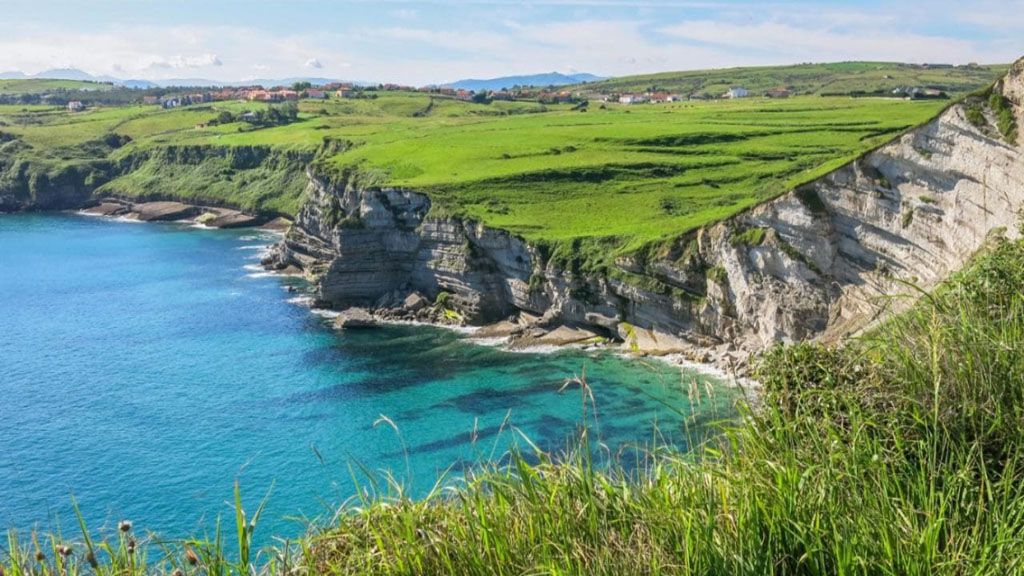
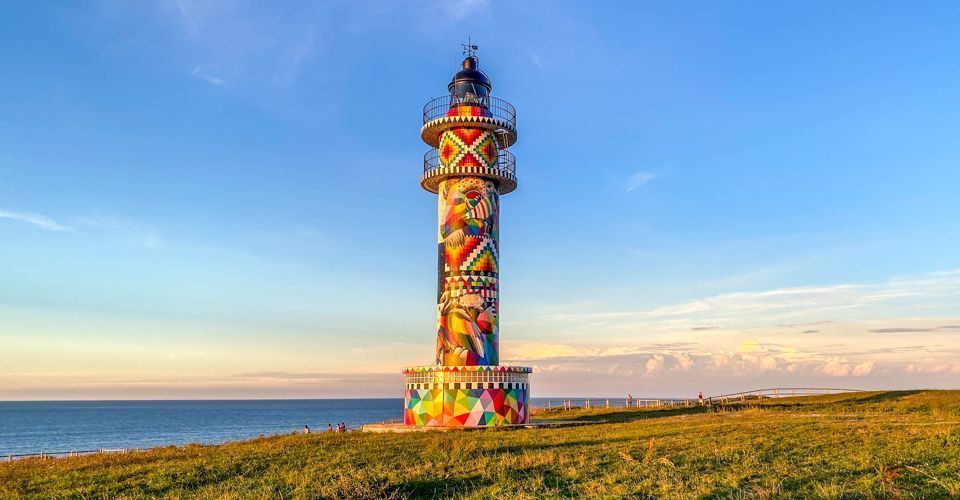
At the northernmost tip of Cantabria, where Cabo de Ajo drops almost seventy metres straight into the Cantabrian Sea, there's a lighthouse that stopped being white six years ago. The Faro de Ajo, in the municipality of Bareyo, is now a mosaic of coloured triangles and spirals by artist Okuda San Miguel, and probably the most photographed landmark on Cantabria's eastern coast.
You don't need to be a pilgrim or an experienced hiker to reach it. The walk in is flat and takes just over half an hour, easy enough for kids or for anyone who only wants a quick photo before heading back to the beach. But the lighthouse deserves more than a five-minute stop: the sixteen-hectare estate around it, the views over the Ría de Ajo and the sea cave at the foot of the cliff are enough to fill a whole afternoon.
Bareyo has a beach, it has the Camino de Santiago, and since 2020 it's had this: a visual icon that holds its own against any painted lighthouse in Greece or Portugal, five minutes by car from the town centre.

Where it is and how to get there
The Faro de Ajo stands on Cabo de Ajo, the northernmost point in Cantabria, within the municipality of Bareyo and barely five minutes by car from the village of Ajo. From Santander it's about 40 kilometres via the A-8 and CA-141; from Bilbao, a bit over 80.
The easiest way in is to leave your car at the Ojerada de Ajo car park, on the road out of Ajo towards the cape, and follow the signposted path on foot. There's nothing complicated about the directions: you can see the lighthouse from the car park on the clear stretches, and the path is straightforward. The Ayuntamiento de Bareyo keeps its tourism website updated with access details and opening hours.
From wartime lighthouse to Okuda San Miguel's canvas
The original lighthouse was built in 1930, after three consecutive shipwrecks on the cape's reefs convinced the authorities the area needed a serious signal. The result: a tower with a range of 15 nautical miles and a distinctive light pattern of three grouped occultations, standing on a 63-metre cliff that drops straight into the Cantabrian Sea.
For ninety years it was white, like any lighthouse. In 2020, Cantabrian painter Óscar San Miguel, known internationally as Okuda, transformed it into one of his signature geometric pieces: saturated-colour triangles wrapping the tower from top to bottom. The intervention is designed to last eight years; from 2028 the lighthouse should return to its original white, so anyone who wants to see it painted has a limited window.

The walk to the lighthouse and the Ojerada cave
From the Ojerada car park to the lighthouse and the nearby Ojerada cave, it's about a 2.9-kilometre round trip along wooden boardwalks that cross the coastal meadow without setting foot on protected ground. It takes a little over an hour, with no tricky climbs: the toughest stretch is the last one, up to the cape's viewpoint, with views over the Ría de Ajo and, on clear days, the Cantabrian mountains in the distance.
The Ojerada cave is a sea cavity at the foot of the cliff, visitable at low tide. It's not a tourist cave with walkways or lighting, but a natural grotto — worth checking the tide tables before heading down, and it rewards anyone who plans ahead with one of the least-seen views in the area.

What you need to know
- Summer and long-weekend hours: every day from 11am to 2pm and 4pm to 9pm
- Rest of the year: Saturdays, Sundays and public holidays from 10am to 2pm
- Entry to the grounds: free; the inside of the lighthouse isn't open to visitors
- Distance from Bareyo: about 5 minutes by car to the Ojerada car park
- Walking route: 2.9 km round trip, easy, suitable for kids
- Ojerada cave: only accessible at low tide, check the tide tables before you go
- Best time for photos: late afternoon, with the light raking across the mural
- Okuda's mural has an expiry date: it's expected to last until 2028
Three shipwrecks were enough in 1930 to put up a lighthouse. Ninety years later, one Cantabrian painter was enough to turn it into the most-shared image on the whole Bareyo coast.
The Faro de Ajo sums up what this corner of Cantabria has to offer: a working structure that still guides ships every night, turned into something that moves people who have no interest in sailing whatsoever. It's also the kind of plan that needs no planning: done in a morning, easily combined with Ajo beach or a stretch of the Camino de Santiago del Norte, and it doesn't cost a cent.
From Bareyo Residences, the lighthouse is a short drive away — one of those things that, once you live here, stop being an excursion and simply become part of the everyday landscape. The villas will be available to book from September 2027.